
It’s a little arrogant to be telling people how to vote but if you haven’t read all the material and you’re running out of time, when you pick up your ballot tomorrow you’re going to find a confusing array of ballot measures and candidates. You probably know my politics by now – essentially, I’m a Minnesota liberal – so if you want to vote a practical progressive slate, here are my recommendations: Continue reading
Category Archives: politics
Fair Play for SoMa – Why I Voted No on Prop B

Published on Nov. 1, 2012 by jamiewhitaker
I want to share with SoMa neighbors why I believe Proposition B, the parks bond, is a bad deal for SoMa and perpetuates the exploitation and neglect of SoMa residents. We should ask for a more equitable parks bond in 2013 or 2014 and refuse to accept Prop B in 2012.
Filed under community services, economics, politics
No on Proposition B – Reform is Needed at San Francisco’s Recreation and Parks Department
By JAMIE WHITAKER
www.rinconhillsf.org
“Recreation and Parks refuses to take the donation of a new park at 333 Harrison Street from Oz Erickson’s Emerald Fund because they refuse to maintain it at $30,000 or so per year. Did I mention that Rincon Hill’s existing buildings contribute about 20 times that amount just to the 2.5 cents per $100 of assessed value Open Space Special Revenue Fund set aside? Instead, SoMa neighborhoods like Rincon Hill are told that we have to form our own non-profits called Community Benefit Districts (CBDs) and tax ourselves a parcel tax in addition to our ad valorem property taxes to take care of any parks in our neighborhoods. When did San Francisco become a supporter of such blatant inequality between geographic regions of the City?” Read more →
Filed under community services, economics, politics, quality of life, social justice
Affordable housing, parks bond and taxes on this month’s agenda
Former Board of Supervisors President Aaron Peskin will argue the case against Proposition B, a ballot measure that asks voters to approve $195 million dollars in general obligation bonds to improve parks, at next week’s meeting of the SoMa Leadership Council. Prop B was put on the ballot by an 11-0 vote of the Board of Supervisors but is opposed by Peskin, two other former Board Presidents (Matt Gonzalez and Quentin Kopp) and a host of community organizations. Taxpayers passed an earlier bond measure worth $185 million in 2008. Opponents say that giving them another $195 million would just encourage more bad management and irresponsible spending. This measure requires a two-thirds vote to pass. Continue reading
Filed under community services, meetings, politics
Tech industry posts “soft-sell” pitch for Gross Receipts Tax ballot measure
The San Francisco Citizens Initiative for Technology and Innovation (also known as “sf.citi”) has posted a video that shows proposed tech solutions to make San Francisco “smarter.” The video also advocates for passage of San Francisco’s Proposition E, a business tax reform measure.
It ends with an advertisement for Proposition E, a ballot measure on the November ballot that’ll be the subject of next week’s SoMa Leadership Council meeting. Prop E proposes to reduce the payroll tax paid by San Francisco firms and replace it with a tax based on gross receipt sales.
“The biggest gift the tech community today can give San Francisco is passing Proposition E to create jobs in San Francisco and small business,” angel investor Ron Conway said last month at a tech industry event. Conway is also chairman of sf.citi.
Kim casts decisive vote to retain Mirkarimi as sheriff
After almost nine hours of discussion and testimony, members of the Board of Supervisors finally prepared to vote on whether Ross Mirkarimi should be removed as sheriff at 9:00 last night. Under current Board rules, Supervisor Jane Kim casts the first vote.
Concluding that “I think it wasn’t shown that when the sheriff grabbed his wife that he used the power of his office to commit violence against her,” Kim voted against removal. Continue reading
Filed under politics
How much tech can one city take?
By David Talbot
San Francisco Magazine
“… ever since his Twitter awakening, [Mayor Ed] Lee has been moving quickly to align his administration with the booming technology industry, shrugging off complaints from the city’s powerful progressives that he’s gotten too cozy with tech moguls, such as investor Ron Conway. The mayor’s proposal to shift business taxes from a payroll-based plan to one based on gross receipts will be on the November ballot, with wide backing from the Board of Supervisors, labor unions, and, of course, Conway. Progressive gadfly Aaron Peskin tapped a deep well of distrust on the left last month when he told the San Francisco Chronicle, ‘The Koch brothers are trying to buy the president of the United States, and Ron Conway has bought himself a mayor.’” Read more →
Filed under art, community services, economics, planning, politics, social justice
SOMCAN decries micro-unit legislation as an assault on “our right to live in this city with dignity and respect”
The term “SRO” freaks people out. They associate it with rundown hotels in the Tenderloin and the tawdry housing found along the Sixth Street corridor. A few years ago, when developers were trying to build projects that at the time were called “market-rate SRO housing,” they were fighting an uphill battle against public perceptions. They’ve found a new champion in Supervisor Scott Wiener and he has come up with new terminology that makes these tiny studio apartments seem less threatening. Continue reading
Filed under community services, open space, planning, politics, quality of life, social justice
Planning Dept.’s obsession with “latest and greatest” is not smart growth

Central Corridor Draft Higher Height Limit Alternative
The focus of the Central Corridor Plan is on high tech. The focus of the revival of Mid-Market is on high tech. The focus of the Bayview/Hunters Point redevelopment is going to be on high tech and now planners would like the focus of the Western SoMa Plan to be on high tech too.
I think high tech is cool but this is getting ridiculous. It’s not the only source of jobs in this city. Continue reading
Bunk-bed-stuffed residences where young programmers and designers work, eat and sleep
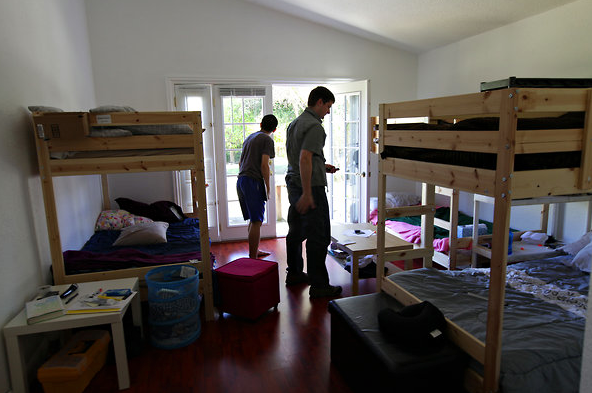
Interesting New York Times piece on “hacker hostels,” informal housing establishments that put a new twist on the long tradition of communal housing for tech types by turning it into a commercial enterprise. Coming in the midst of the student housing, smaller minimum unit size and reduction in open space legislation, it makes you wonder if this isn’t what Supervisor Scott Wiener and Mayor Ed Lee have in mind … visit the New York Times to read more.
Filed under planning, politics, quality of life



 soma leadership council